
Back to: AI for Essential Digital Skills
Introduction to AI
Unpacking Artificial Intelligence: From core principles like Machine Learning to the transformative potential of Generative AI.
Will AI Replace You?
“No, AI will not be replacing you. But the person who knows how to use AI (better) might be replacing you.”
Overview: The Foundation and Necessity
Why Learn AI?
Learning AI is no longer optional; it’s essential for both personal and professional growth. The rapid integration of AI across all sectors is reshaping the job market, driving economic growth, and creating new, high-value career paths.
Job Market & The Skills Gap
AI is not just a niche field; it’s a fundamental shift in how work is done. The demand for AI skills is skyrocketing, while a significant talent gap persists, making those with AI knowledge highly valuable.
- Job Disruption and Creation: The World Economic Forum’s “Future of Jobs Report” predicts that by 2027, 83 million jobs may be displaced by AI, but 69 million new ones will also be created, resulting in a net loss of 14 million jobs globally. This underscores the need for upskilling to adapt to this new landscape. (World Economic Forum, 2023)
- High Demand for AI Professionals: A study by Reuters found an expected 50% AI talent gap, with many organizations struggling to find employees with the necessary skills to implement AI projects. (Reuters, 2024)
- High-Paying Careers: The high demand and low supply of skilled AI professionals mean that AI-related jobs are among the highest-paying in the tech industry. As of 2025, the World Economic Forum predicted 97 million AI job opportunities to be created. (World Economic Forum, 2022)
Economic Growth
AI is a major driver of global economic growth and a key differentiator for companies seeking a competitive edge. Learning AI allows individuals to contribute to and lead this innovation.
- Trillions in Economic Value: A PwC report estimates that AI could contribute up to $15.7 trillion to the global economy by 2030, a figure larger than the current combined output of China and India. (PwC)
- AI Adoption by Businesses: Over 85% of organizations are currently using AI services or tools, with 92% of executives expecting to boost their AI spending in the next three years. This shows the widespread business commitment to AI and the need for a skilled workforce. (Wiz, 2025; McKinsey & Company, 2025)
- Operational Efficiency: The top reasons businesses are implementing AI are to improve operational efficiency (48%), enhance customer experience (44%), and foster innovation (42%). (Enterprise Strategy Group, 2025)
What is AI?
OECD.AI Definition
“An AI system is a machine-based system that, for explicit or implicit objectives, infers, from the input it receives, how to generate outputs such as predictions, content, recommendations, or decisions that can influence physical or virtual environments.”
- “Programmes that can sense, reason, act and adapt.”
- “A machine that can perform tasks that typically require human intelligence.”
The Evolution of AI
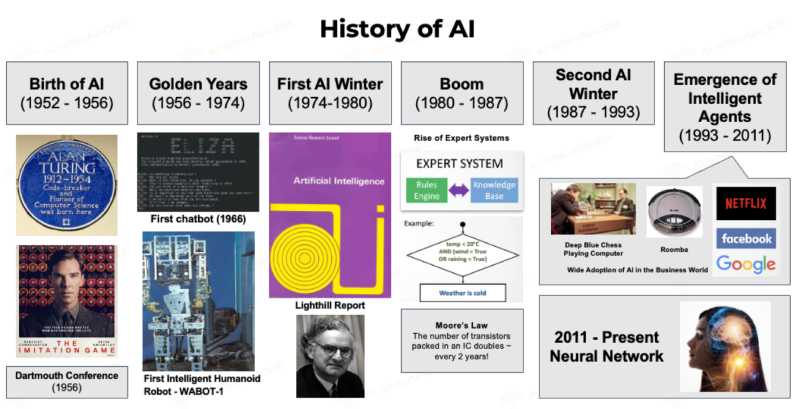
Birth of AI
The true history of AI begins in the 1950s, a period we call the Birth of AI. This era is defined by one visionary gentleman: Alan Turing. He is widely regarded as the Father of Computer Science and AI. During World War II, Turing devised the algorithms that successfully broke the German’s Enigma code—a feat credited with significantly shortening the war. Crucially, these foundational algorithms and the philosophical work on ‘thinking machines’ gave birth to the field of Artificial Intelligence. This era was formally inaugurated by the Dartmouth Conference in 1956.
Golden Years
Following the Dartmouth Conference, we entered the Golden Years of AI. Optimism was sky-high. Progress was rapid, and by the 1960s, we had tangible results. In this period, we saw the first AI chatbot, named ELIZA, which could simulate conversation. Not only that, but the Japanese also built the first intelligent humanoid robot, WABOT-1—which, while impressive, was certainly wired up and not fully autonomous as we know them today!
First AI Winter
However, this initial optimism eventually ran into the hard reality of computational limitations. AI research suffered a major funding cut and lost public trust, leading to the First AI Winter. A key event during this time was the Lighthill Report, which was highly critical of the limited progress and ultimately led to the British government ceasing funding for AI research.
Boom: The Rise of Expert Systems
Luckily, AI found its footing again in the 1980s. This period saw a Boom driven by the development of Expert Systems. An Expert System is essentially a program designed to mimic the decision-making ability of a human expert. It consists of a Rules Engine and a Knowledge Base. They were quite successful because they focused on narrow, well-defined problems, like medical diagnosis or financial risk assessment. This boom was also underpinned by Moore’s Law, as computing power trying to catch up with AI’s demands.
Second AI Winter
Unfortunately, the Expert Systems boom didn’t last. While they worked well for narrow problems, they proved too costly and complex to maintain and couldn’t scale well to real-world, larger applications. Compounding this issue, despite the growth predicted by Moore’s Law, the actual computing power was still not powerful or fast enough to handle the incredibly complex, computationally intensive methods—especially early forms of neural networks—that researchers were trying to develop. This simultaneous disappointment with existing systems and the inability to push new, more complex techniques led to a significant loss of funding and the resulting Second AI Winter.
Emergence of Intelligent Agents
But AI didn’t die. It became an integral part of real-world applications. This era, characterized by the Emergence of Intelligent Agents, saw AI move from the lab into the business world and our homes. We saw the first major public demonstration of AI dominance in 1997 when IBM’s Deep Blue Chess Playing Computer defeated World Champion Garry Kasparov. Shortly after, consumer-level AI arrived with products like the Roomba vacuum cleaner. Crucially, major internet companies like Google, Facebook, and Netflix began utilizing AI to power search, recommendations, and targeted advertising, marking the wide adoption of AI in the business world.
The Neural Network Revolution
And that brings us to the modern era, starting around 2011. This period is defined by a massive leap forward, driven by the resurgence of Neural Networks and Deep Learning—fueled by immense datasets and powerful GPUs. This is the era of AI that we are living in today.
Key Concepts & Structure
AI Technological Evolution
Artificial Intelligence (AI)
1950sSensing, Reasoning, Acting, and Adapting.
Machine Learning (ML)
1980sAlgorithms learning patterns from data.
Deep Learning (DL)
2000sNeural Networks & Big Data.
Generative AI
2010sCreates ORIGINAL content.
Types of AI
- Excellent in performing narrowly defined task.
- E.g., AI writing assistants, self-driving vehicles.
- Also known as Weak AI.
- Perform general intellectual tasks that a human can do.
- E.g., Coffee Test, Sonny robot in movie I-Robot.
- Also known as Strong AI.
- Exhibits creativity, general wisdom & emotions.
- Able to reprogram & improve itself infinitely.
- Beyond human intelligence.
Generative AI: Creation Engine
Generative AI is a type of artificial intelligence that creates new, original content like text, images, code, music, or videos, by learning patterns from massive datasets, unlike traditional AI that just analyzes or categorizes existing data. Using deep learning and neural networks, it generates novel outputs that mimic human creativity in response to user prompts, making it revolutionary for content creation, coding, and design. Types of content include:
Machine Learning: The Core
Machine learning is a subset of artificial intelligence that focuses on the development of algorithms and statistical models that enable computers to perform tasks without explicit instructions. Instead, these systems learn from data, identifying patterns and making decisions based on the input they receive.
Core Components
The foundation (numbers, text). Ex: Purchase history.
Rules for analysis. Ex: Decision trees, Neural networks.
Adjusting parameters to improve accuracy. Ex: Learning features of “cats” vs “dogs”.
Evaluating performance on unseen data.
Input & Output Terminology
Individual measurable properties or characteristics used by algorithms for prediction.
Ex: In predicting house prices, features might include square footage, number of bedrooms, location, etc.
The outcome we want our machine learning model to predict; often referred to in supervised learning scenarios.
Ex: In email classification (spam vs. not spam), labels would be “spam” or “not spam.”
The Three Learning Paradigms
Supervised vs Unsupervised Learning
Models are trained on labeled datasets where both inputs (features) and desired outputs (labels) are known.
Ex: Predicting sales based on historical sales data with known outcomes (labels).
Models work with unlabeled data to find hidden patterns or intrinsic structures within the input data (e.g., clustering).
Ex: Grouping customers into segments based on purchasing behavior without prior knowledge about those groups.
Reinforcement Learning
A type of machine learning where an agent learns by interacting with its environment through trial and error while receiving feedback in terms of rewards or penalties.
Ex: Training a robot to navigate through obstacles by rewarding successful maneuvers while penalizing collisions.
Practical: Understanding Machine Learning
Experience ML classification: Quick Draw (That’s Machine Learning in action!)

ML vs. Deep Learning
| Aspect | Machine Learning (ML) | Deep Learning (DL) |
|---|---|---|
| Definition | Algorithms that learn patterns from data. | Subset of ML using multi-layered neural networks. |
| Complexity | Moderate; needs human feature selection. | High; automatic feature discovery. |
| Data Needs | Works with smaller datasets. | Needs huge datasets. |
| Training | Generally faster. | Much slower (deep layers). |
| Use Case | House prices, fraud detection. | Image recognition, self-driving cars. |
Capabilities of AI Tools: Augmenting Human Work
Artificial Intelligence (AI) tools are rapidly transforming the workplace by acting as practical solutions to make routine tasks less time-consuming. AI functions as a collaborative co-pilot, extending our cognitive abilities to help us make better decisions and solve problems faster.
Content Generation and Creativity
AI can generate new content, such as text, images, or other media.
It can assist marketing teams by creating promotional videos for new products.
Generative AI can draft email replies and enhance brainstorming sessions.
Information Analysis and Optimization
AI excels at quickly processing and analyzing large amounts of data.
AI can analyze information in spreadsheets in seconds and draft detailed reports highlighting key insights.
It can quickly analyze long email threads, highlighting the key points.
AI can streamline business operations, improve product quality, and automate or assist with various tasks, such as routing GPS directions or real-time translation.
Core AI Functions
At a basic level, AI systems are trained to learn from data and can perform tasks such as:
Limitations of AI Tools: Recognizing the Pitfalls
While AI is a powerful tool, it is not a magic solution for every business problem and has significant limitations that require careful thought and consideration.
Key Limitations
-
Inaccuracies and Hallucinations:
AI outputs can sometimes contain inaccuracies, commonly known as hallucinations.
- These inaccuracies can range from minor errors to significant distortions, potentially leading to misguided decisions if the output is not reviewed.
- For example, an AI might incorrectly flag a product for removal without factoring in seasonal sales patterns.
-
Dependence on Human Input:
AI cannot learn independently; it requires people to continually update its training.
-
Bias in Training Data:
A fundamental issue is the potential for bias within the training data.
- Shortcomings in the training data can unintentionally reflect or amplify existing biases, leading to skewed or unfair outcomes.
- If a tool is trained only on images of specific types of apples, it will be inaccurate when identifying other variations, leading to incorrect sorting.
-
Need for Human Judgment:
Certain tasks that require a human touch, such as handling sensitive issues, are beyond AI’s capabilities.
Human Oversight: The Critical Need
Although AI is a powerful tool, it functions best as a co-pilot and still requires human oversight and ethical considerations to be truly useful. Recognizing the need for human oversight is a key learning objective in implementing AI solutions effectively.
Ensuring Accuracy and Ethics
Human oversight is crucial for validating the output generated by AI tools.
- It ensures that the information used for decision-making is accurate and ethical.
- By auditing AI outputs, professionals can establish necessary safeguards for responsible deployment in various business functions.
Mitigating AI Risks
Oversight is essential for managing the risks inherent in modern AI models.
- It helps mitigate common challenges such as biased outputs, data privacy concerns, and security risks in automated systems.
Aligning with Organizational Values
Effective management of AI requires human input to ensure that the tool’s decision-making processes and outputs are aligned with the values that benefit people.